Queer Places:
Alderley Park, Congleton Road, Nether Alderley, Macclesfield, Cheshire, SK10 4TG, United Kingdom
Pembroke House, Richmond Park, Richmond, London, TW10 5HS, United Kingdom
Winchester College, College St, Winchester SO23 9NA, United Kingdom
University of Oxford, Oxford, Oxfordshire OX1 3PA
Telegraph House, Compton, Chichester, West Sussex, PO18 9QL
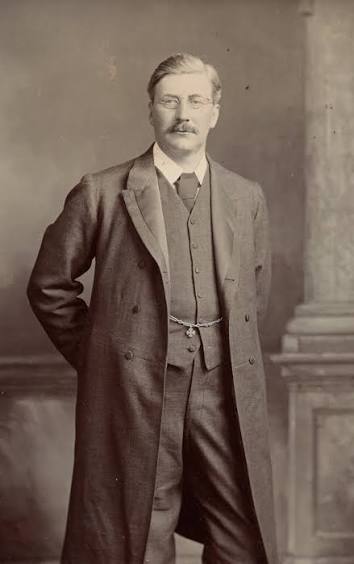 John Francis Stanley Russell, 2nd Earl Russell (August 12, 1865 – March 3, 1931)—widely known as Frank Russell—was born on August 12, 1865, at Alderley
Park in Cheshire, England. He was the eldest child of Viscount and Viscountess Amberley, and the grandson of the renowned British Prime Minister John
Russell, 1st Earl Russell. Descending from two prominent Whig families, Frank grew up in an unconventional household that championed birth control,
feminism, and radical political reforms. His parents rejected religious orthodoxy, allowing him to roam the countryside and explore science and engineering
from an early age. His upbringing changed dramatically following a family tragedy: after a journey to Italy in late 1873, both his mother and sister died
of diphtheria in mid-1874, followed by his father's death from pneumonia in January 1876. Following a legal battle over guardianship, Frank and his younger
brother, Bertrand Russell, were placed under the strict supervision of their conservative paternal
grandparents at Pembroke House.
John Francis Stanley Russell, 2nd Earl Russell (August 12, 1865 – March 3, 1931)—widely known as Frank Russell—was born on August 12, 1865, at Alderley
Park in Cheshire, England. He was the eldest child of Viscount and Viscountess Amberley, and the grandson of the renowned British Prime Minister John
Russell, 1st Earl Russell. Descending from two prominent Whig families, Frank grew up in an unconventional household that championed birth control,
feminism, and radical political reforms. His parents rejected religious orthodoxy, allowing him to roam the countryside and explore science and engineering
from an early age. His upbringing changed dramatically following a family tragedy: after a journey to Italy in late 1873, both his mother and sister died
of diphtheria in mid-1874, followed by his father's death from pneumonia in January 1876. Following a legal battle over guardianship, Frank and his younger
brother, Bertrand Russell, were placed under the strict supervision of their conservative paternal
grandparents at Pembroke House.
Frank found his grandparents' household stifling, though he thrived during his four happy years at Winchester College from 1879 to 1883. It was at
Winchester that he formed a profound bond with the future poet Lionel Johnson. Frank subsequently matriculated
at Balliol College, Oxford, to read classics under the mastership of Benjamin Jowett. However, his academic career was abruptly cut short in May 1885 when
Jowett sent him down, likely due to institutional suspicions surrounding his close relationship with Lionel Johnson. Deeply resentful of his treatment,
Frank traveled to the United States, where he met Walt Whitman, President Grover Cleveland, and the young
George Santayana. Upon coming into his inheritance in August 1886, Frank pursued various commercial ventures,
including electrical engineering, and eventually entered public service. He served on the London County Council from 1895 to 1904, championing progressive
municipal policies.
Frank Russell’s personal life was defined by turbulent marriages and historic legal battles that earned him the moniker the "Wicked Earl." His first
marriage, to Mabel Edith Scott in 1890, rapidly dissolved amidst acrimonious separation and a landmark legal battle over cruelty that culminated in the
House of Lords decision Russell v. Russell. In 1899, he traveled to Nevada with Marion "Mollie" Somerville and obtained a divorce, marrying Mollie shortly
thereafter. Because English law did not recognize foreign divorces, Russell was arrested for bigamy upon his return. In July 1901, he stood trial before
the House of Lords in the Royal Gallery—the last time a British peer was tried by the Lords—and was sentenced to three months in Holloway Prison. He
eventually received a free pardon from Winston Churchill in 1911. Mollie and Frank separated later on, and
in 1916 he married his third wife, the novelist Elizabeth von Arnim. This marriage also collapsed swiftly, inspiring von Arnim to caricature him in her
1921 novel Vera.
As a member of the House of Lords, Russell campaigned passionately for divorce law reform and motorists' rights, becoming an early advocate for drivers
after being called to the Bar in 1905 and famously queuing all night to secure the vehicle registration plate "A1". Politically, he took increasingly
liberal stances, strongly supporting the Parliament Act 1911 to diminish the power of the Lords and becoming the first peer to join the Fabian Society in
December 1912. During the First World War, he supported the war effort while fiercely defending civil liberties, aligning with his brother Bertrand's
pacifist views and standing as one of only two peers to oppose Asquith's conscription bill in 1916. He also actively assisted Bertrand during his anti-war
prosecution and imprisonment in 1918.
Fully embracing the Labour Party upon its rise to power, Russell proved his worth through dedicated committee work and debate. In Ramsay MacDonald's
second government (1929–1931), he was appointed Parliamentary Secretary to the Minister of Transport, where he successfully steered the Road Traffic Act
1930 through the Lords—abolishing the outdated 20 mph speed limit—and introduced the Mental Treatment Act 1930 to improve psychiatric care. He was
subsequently promoted to Under-Secretary of State for India, participating as a delegate in the First Round Table Conference. While vacationing and
recovering from influenza on the Riviera, Frank Russell suffered a sudden heart attack and died in Marseille on March 3, 1931. His remains were cremated,
and his ashes were scattered near Telegraph House.
Frank Russell’s life intersected in fascinating ways with the intellectual and personal world of the Spanish-American philosopher and poet George
Santayana. Their connection began during Santayana's undergraduate years at Harvard University in 1886, when a friend introduced Russell—then adrift after
being expelled from Oxford—to Santayana at Hollis Hall. Santayana was immediately captivated by Russell's striking physical presence, noting his tall
stature, tawny hair, steel-blue eyes, and florid complexion. Though Santayana was attracted to Russell's sharp intellect, he was simultaneously repelled by
his superficiality and hypocrisy, setting the tone for a complex, thirty-year love-hate dynamic.
When Santayana permanently relocated to Europe in 1912, their paths crossed again in England. Frank—described by Santayana as masculine, extroverted,
and hopelessly heterosexual, yet possessing deep technical competence and a passion for sailing—welcomed the prim Harvard scholar into his orbit. This
encounter marked the beginning of a lifelong devotion on Santayana's part. Santayana willingly absorbed and shared the burdens of Russell's chaotic
personal life, acting as a confidant through the endless, scandal-ridden matrimonial troubles brought on by Russell's relentless romantic escapades.
References:
Other references:
- Russell, Frank. My Life and Adventures. London: Cassell & Co., 1923. (Frank Russell's autobiographical account of his early life, legal battles, and social views).
- Russell, Frank. Lay Sermons. London: Watts & Co., 1901. (Written during his imprisonment in Holloway Prison, reflecting his agnosticism and ethical views).
- Russell, Frank. Divorce. London: William Heinemann, 1912. (Russell's political and legal arguments advocating for divorce law reform).
- Santayana, George. Persons and Places: The Background of My Life. New York: Charles Scribner's Sons, 1944. (Contains extensive firsthand reflections on his decades-long friendship with Frank Russell)
- Some Winchester Letters of Lionel Johnson. (Published anonymously by Frank Russell in 1919, compiling correspondence between Russell and the poet Lionel Johnson from their school days).
- Derham, Ruth. The Wicked Earl: The Life and Trials of Frank Russell. London: The History Press, 2016. (The definitive modern biography examining his turbulent life, marriages, and legal notoriety).
- Monk, Ray. Bertrand Russell: The Spirit of Solitude, 1872–1921. New York: Free Press, 1996. (Provides deep contextual insight into the Russell family background, upbringing under their grandparents, and Frank's relationship with Bertrand).
- Savage, Gail L. The Making of the 1930 Road Traffic Act and Divorce Law Reform. (Scholarly examinations of Frank Russell's legislative efforts in the House of Lords).
- Harpster, Jack. Articles and essays concerning Frank Russell's pioneering Nevada divorce and its legal fallout in Edwardian Britain.
- Furneaux, Rupert. Tried by their Peers. London: Cassell, 1959. (Includes a detailed historical chapter covering Frank Russell's 1901 bigamy trial before the House of Lords).
- Debrett's Peerage, Baronetage, Knightage, and Companionage. (Annual editions from the late 19th and early 20th centuries documenting his succession to the earldom and peerage records).
- Hansard. Parliamentary Debates of the House of Lords (1887–1931), recording his legislative work, opposition to conscription, and contributions on the Labour front bench.
Support this project
This website is a passion project researched, developed, and funded entirely by me. If you find the content valuable and would like to help support the ongoing research and hosting costs, any contribution is deeply appreciated.
Thank you for keeping this independent resource alive!
My books on Amazon: Elisa Rolle's books
BACK TO HOME PAGE